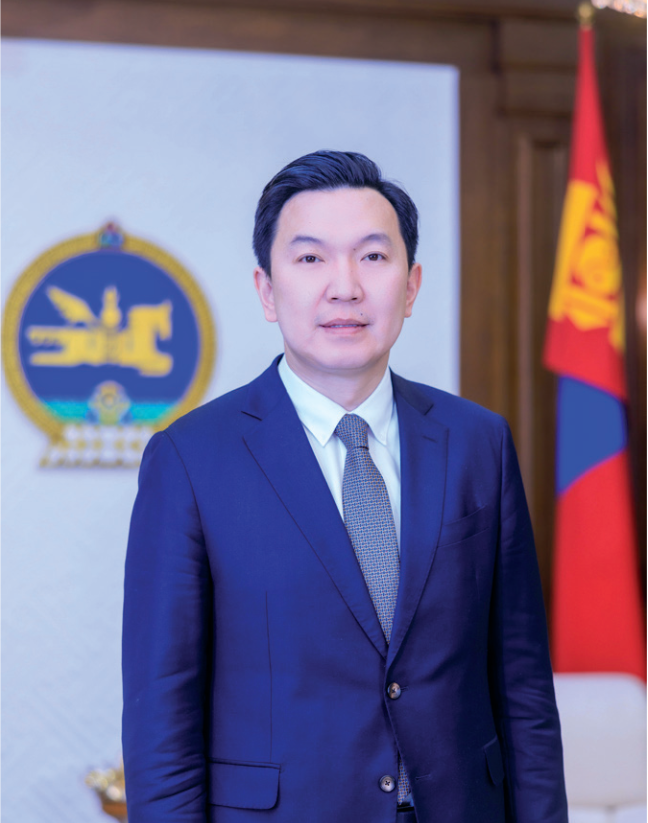
FOREWORD BY THE PRIME MINISTER OF MONGOLIA
Dear Readers,
It is my pleasure to present to you the National Report on the State of Mongolia’s Rangelands. This report is an important policy and planning document that brings together, on a scientific basis, the current condition of Mongolia’s rangeland resources, trends in their change, their potential to recover, and the measures needed for their protection, sustainable use and restoration.
This report is being published at a particularly important moment. The Government of Mongolia is hosting the Seventeenth Session of the Conference of the Parties to the United Nations Convention to Combat Desertification (UNCCD COP17) in Ulaanbaatar from 17 to 28 August 2026. The UNCCD COP17 will provide a major global platform for addressing land degradation, desertification, drought and sustainable land management.
At the same time, 2026 has been proclaimed by the United Nations as the International Year of Rangelands and Pastoralists (IYRP 2026). This International Year offers a unique opportunity to raise global awareness of the importance of rangeland ecosystems, the livelihoods of nomadic and pastoral communities, traditional knowledge, biodiversity, food systems, and resilience to climate-related risks and disasters.
The convergence of these two important milestones creates a timely opportunity for Mongolia to share with the international community its long-standing experience in traditional livestock husbandry, nomadic civilization and sustainable rangeland management. For Mongolia, rangelands are not merely a feed base for livestock. They are the foundation of rural livelihoods, ecosystem services, cultural heritage and national sustainable development. Accurately assessing the condition of rangelands, monitoring changes over time and strengthening science-based management are therefore among the most urgent priorities of our time.
This report is significant because it identifies how rangeland monitoring can support rangeland protection, restoration and local decision-making. It is not only a technical assessment, but also a document that supports evidence-based decision-making through the collaboration of government institutions, local authorities, herders, researchers and development partners.
Looking ahead, Mongolia will continue to expand international cooperation to reduce land degradation, safeguard the recovery potential of rangelands, support herder livelihoods and strengthen sustainable rangeland management. We are committed to sharing our national experience and good practices at the global level. I am confident that this report will make an important contribution to that shared goal.
UCHRAL NYAM-OSOR
PRIME MINISTER OF MONGOLIA
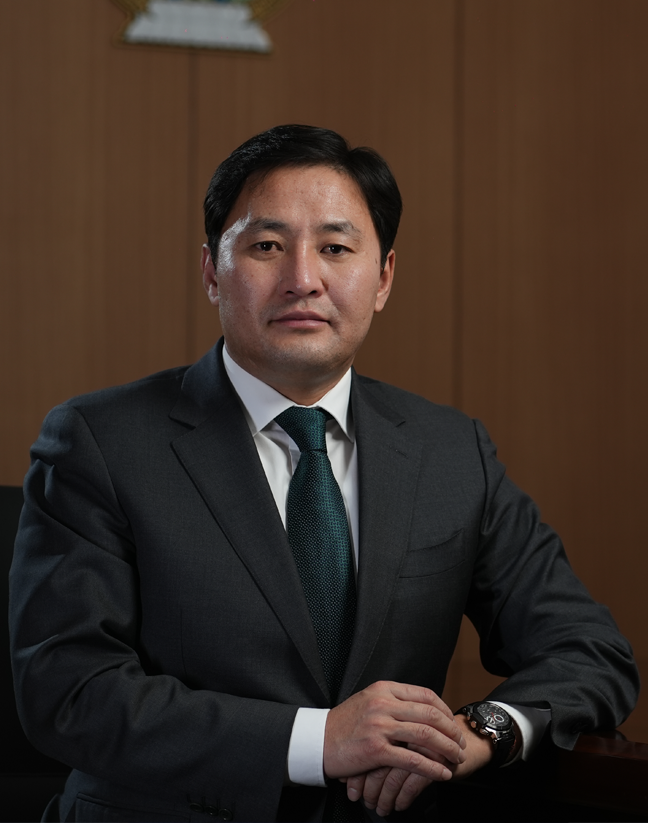
EDITOR’S WORDS
Land degradation, pollution, unsustainable land use and land-related conflicts are becoming increasingly complex and pressing, driven by population concentration, urbanization, mining, intensified land use in the livestock and infrastructure sectors, and the impacts of climate change. In this context, the need to accurately assess land condition, land quality and land-use change through science-based data, analysis and advanced technologies, and to implement effective measures for the sustainable use, protection and restoration of land, has become an urgent priority not only for Mongolia, but also for the global community.
Pastoral livestock husbandry is not merely an economic sector for Mongolia. It is an inseparable part of the country’s environment, national history, culture and social fabric. Developing pastoral livestock husbandry in a way that supports national security, environmental sustainability and ecological balance is therefore one of the foremost priorities of our time. For many years, Mongolia has faced the need to assess livestock systems not only through quantitative indicators such as fodder availability and carrying capacity, but also through a more comprehensive understanding of rangeland productivity, vegetation composition, levels of degradation and recovery potential. Integrating effective approaches for the sustainable use, protection and restoration of this vital natural resource into land management policy, planning, implementation, monitoring and evaluation is essential for the long-term sustainability of rangeland-based livestock husbandry.
The Law of Mongolia on Land provides for the long-term contractual use of rangelands in accordance with seasonal grazing arrangements. It also establishes the basis for a national monitoring network to track changes in rangeland condition. In line with these functions, the General Authority for Land Administration, Geodesy and Cartography has been implementing the “Assessment of Rangeland Change through Photo Monitoring” since 2015.
This work has supported important progress in several areas. It has strengthened the monitoring of changes in rangeland condition, quality and productivity in relation to land-use impacts. It has also helped adjust rangeland use and carrying capacity based on recovery potential. In addition, it has contributed to assessing the implementation of rangeland use agreements. Over time, the methodology, institutional arrangements and use of monitoring information have continued to improve.
This report presents the results of broad collaboration among national and local institutions, researchers, development partners and herder communities. It helps establish an evidence base for preparing different level land management plans, regulating rangeland use, and identifying priority measures for rangeland restoration and protection. These efforts are grounded in the results of the national photo monitoring system.
Looking ahead, it will be important to further strengthen human resource capacity and support the continued participation of local specialists. Expanding the coverage of rangeland photo monitoring and ensuring its sustained implementation will also be essential to improving the effectiveness of this work.
I would like to express my sincere gratitude to all government and non-government institutions, local authorities, professional associations, research organizations, international organizations, project teams, working group members, local communities and herders who contributed to the assessment of Mongolia’s rangelands and to the preparation of this national report.
The publication of this report in connection with the Seventeenth Session of the Conference of the Parties to the United Nations Convention to Combat Desertification (UNCCD COP17) provides an important opportunity to showcase Mongolia’s rangeland management experience. It also highlights the value of science-based assessment at both national and international levels.
I am confident that this report will make an important contribution to demonstrating Mongolia’s leadership in sustainable rangeland use and management. I wish you every success in your work.
ENKHMANLAI ANAND
Director General General Authority for Land Administration and Management, Geodesy and Cartography.
EXECUTIVE SUMMARY
Mongolia has a long-standing tradition of nomadic livestock husbandry. Today, approximately 30 percent of the country’s population depends on pastoral livestock husbandry for their livelihoods, and the sector accounts for around 12 per cent of gross domestic product. Traditional nomadic livestock husbandry remains an important foundation of both the national economy and rural livelihoods.
The current condition and future trajectory of Mongolia’s rangelands depend directly on sound policy decisions, sustainable management, and shared responsibility based on local participation. For this reason, rangeland management is of strategic importance for the country’s long-term sustainable development. Reports by the Food and Agriculture Organization of the United Nations and the World Bank note that more than 20 million head of livestock were lost during the dzud events of 2000–2002 and 2009–2010, with serious consequences for the stability of the livestock sector and the wider economy1,2. Numerous scientific studies have also shown that increasing livestock numbers, unregulated grazing pressure and declining ecosystem resilience are contributing to rangeland degradation.
As the basis of Mongolia’s nomadic economy, way of life, culture and herder livelihoods, the condition and quality of rangelands are not only environmental concerns. They are also fundamental indicators of social and economic development.
According to the Unified Land Fund Report of Mongolia for 2025, rangelands account for 82.7 per cent of the country’s total territory, including rangeland areas located within state special protected areas. Accurately assessing and regularly monitoring changes in rangeland condition and quality are essential for planning and implementing effective measures for rangeland protection, restoration and sustainable use.
Since 2015, the Agency for Land Administration and Management, Geodesy and Cartography has been implementing rangeland change assessment through photo monitoring at the national level. Under this system, annual surveys are conducted every August at 5,322 monitoring points covering 129.3 million hectares of rangelands across 21 aimags, 330 soums and six districts of the capital city. The collected data are processed, analysed and stored in the integrated land monitoring database.
Rangeland photo monitoring is a practical and cost-effective approach that generates long- term time-series data from fixed monitoring locations. It makes it possible to detect changes in vegetation cover, vegetation structure, productivity, degradation levels and recovery potential.
PART 1 - INTRODUCTION
- 1.1. RATIONALE
- 1.2. PURPOSE AND OBJECTIVES
- 1.3. SCOPE OF THE REPORT
- 1.4. PRINCIPLES AND DISTINCTIVE FEATURES OF THE REPORT
PART 2 - METHODOLOGY FOR ASSESSING RANGELAND CONDITION AND QUALITY
- 2.1. HISTORY OF DEVELOPING THE METHODOLOGY FOR ASSESSING RANGELAND QUALITY AND CONDITION
- 2.2. METHODOLOGICAL BASIS OF RANGELAND PHOTO MONITORING
- 2.3. FIELD SURVEY METHODS
- 2.4. METHODOLOGY FOR PROCESSING RANGELAND PHOTO MONITORING DATA
- 2.5. RANGELAND STATE-AND TRANSITION MODELS
- 2.6. RANGELAND ECOLOGICAL SITE GROUPS
- ...
PART 3 - THE CONDITION OF MONGOLIA’S RANGELANDS BASED ON PHOTO MONITORING RESULTS, 2020–2025
- 3.1. NATIONAL RANGELAND ASSESSMENT BY RECOVERY CLASS
- 3.2. ANALYSIS LINKED TO RECOVERY CLASSES
- 3.3. COMPARATIVE ASSESSMENT OF RANGELAND CONDITION AND RECOVERY CLASSES BY NATURAL ZONE
- 3.4. RESULTS OF RANGELAND MONITORING AT THE AIMAG LEVEL
PART 4 - USE OF PHOTO MONITORING RESULTS AND MEASURES FOR RANGELAND PROTECTION AND RESTORATION
- 4.1. PRINCIPLES FOR ALIGNING RANGELAND USE WITH RECOVERY CLASS
- 4.2. USE OF PHOTO MONITORING RESULTS IN LAND MANAGEMENT PLANNING
- 4.3. THE “RESPONSIBLE NOMAD” STANDARD AND RANGELAND MONITORING
- 4.4. LOCAL APPLICATION OF PHOTO MONITORING RESULTS: THE CASE OF NOROVLIN SOUM, KHENTII AIMAG
PART 5 - LEGAL, TECHNICAL AND TECHNOLOGICAL INNOVATION
- 5.1. LEGAL REFORMS RELATED TO RANGELAND USE AND PROTECTION
- 5.2. KEY AMENDMENTS TO THE LAW OF MONGOLIA ON LAND INTRODUCED IN 2024
- 5.3. DIGITAL TECHNOLOGIES INTRODUCED INTO RANGELAND PHOTO MONITORING
- 5.4. UPGRADING FIELD SURVEY TOOLS AND EQUIPMENT
PART 6 - PARTNERSHIP, SCIENTIFIC COOPERATION AND CAPACITY DEVELOPMENT
- 6.1. COOPERATION ESTABLISHED WITH SCIENTIFIC INSTITUTIONS
- 6.2. RANGELAND-RELATED DISCUSSIONS, CONSULTATIONS AND FORUMS
- 6.3. CAPACITY DEVELOPMENT, KNOWLEDGE EXCHANGE AND SPECIALIST TRAINING
- 6.4. PARTNERSHIPS
- 6.5. PARTICIPATION IN INTERNATIONAL CONFERENCES AND MEETINGS AND PRESENTATION OF RANGELAND PHOTO MONITORING
- 6.6. USE OF RANGELAND PHOTO MONITORING AND ITS RESULTS IN SCIENTIFIC AND OTHER RESEARCH
PART 7 - POLICY RECOMMENDATIONS
- 7.1. RECOMMENDATIONS FOR UPDATING THE LEGAL FRAMEWORK AND IMPROVING METHODOLOGIES
- 7.2. RECOMMENDATIONS FOR IMPROVING RANGELAND PHOTO MONITORING OPERATIONS
- 7.3. RECOMMENDATIONS FOR IMPROVING THE RANGELAND MONITORING DIGITAL SYSTEM AND DATABASE
- 7.4. RECOMMENDATIONS FOR LOCAL DECISION-MAKERS
- 7.5. RECOMMENDATIONS FOR HERDERS
PART 8 - ANNEX
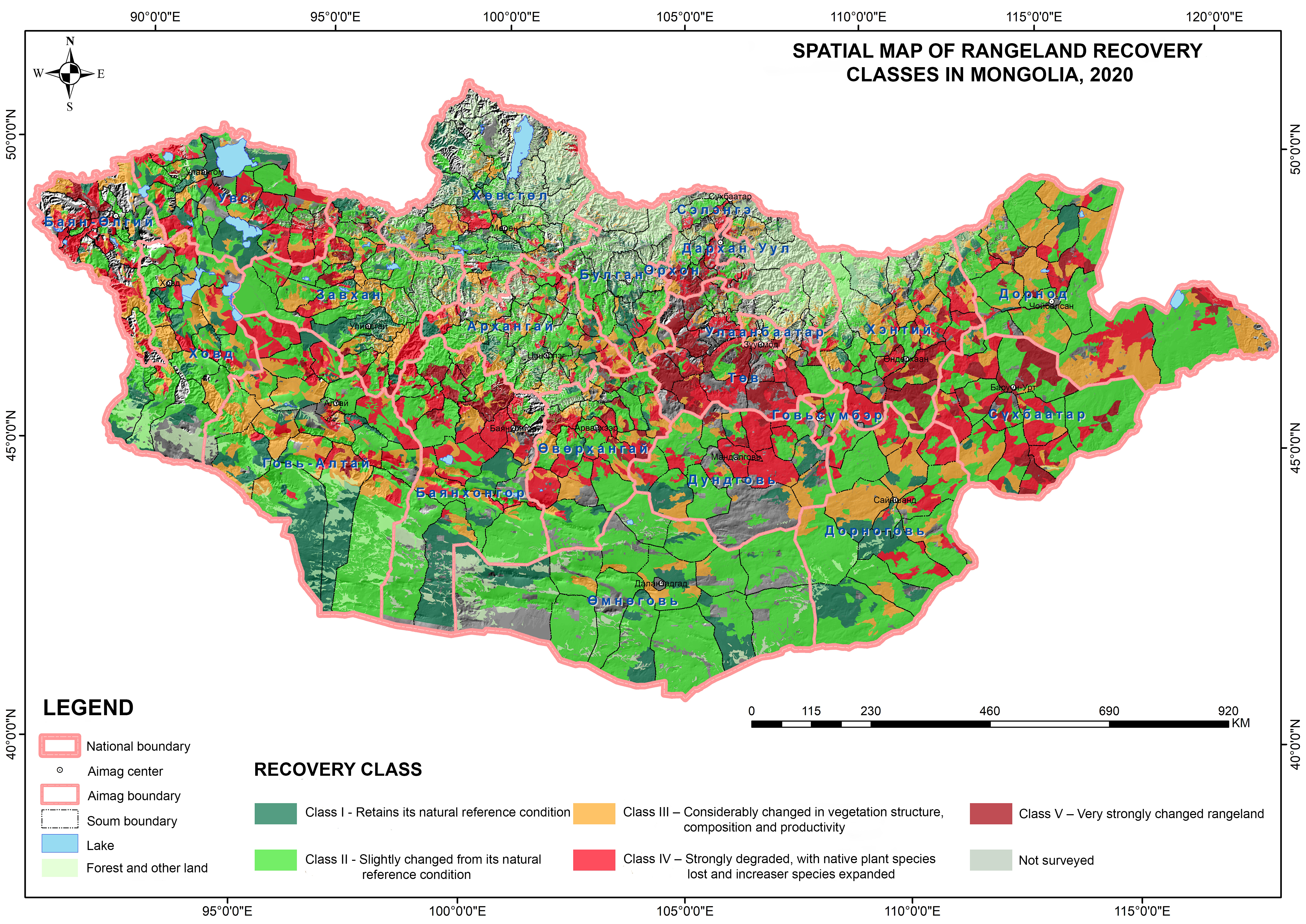
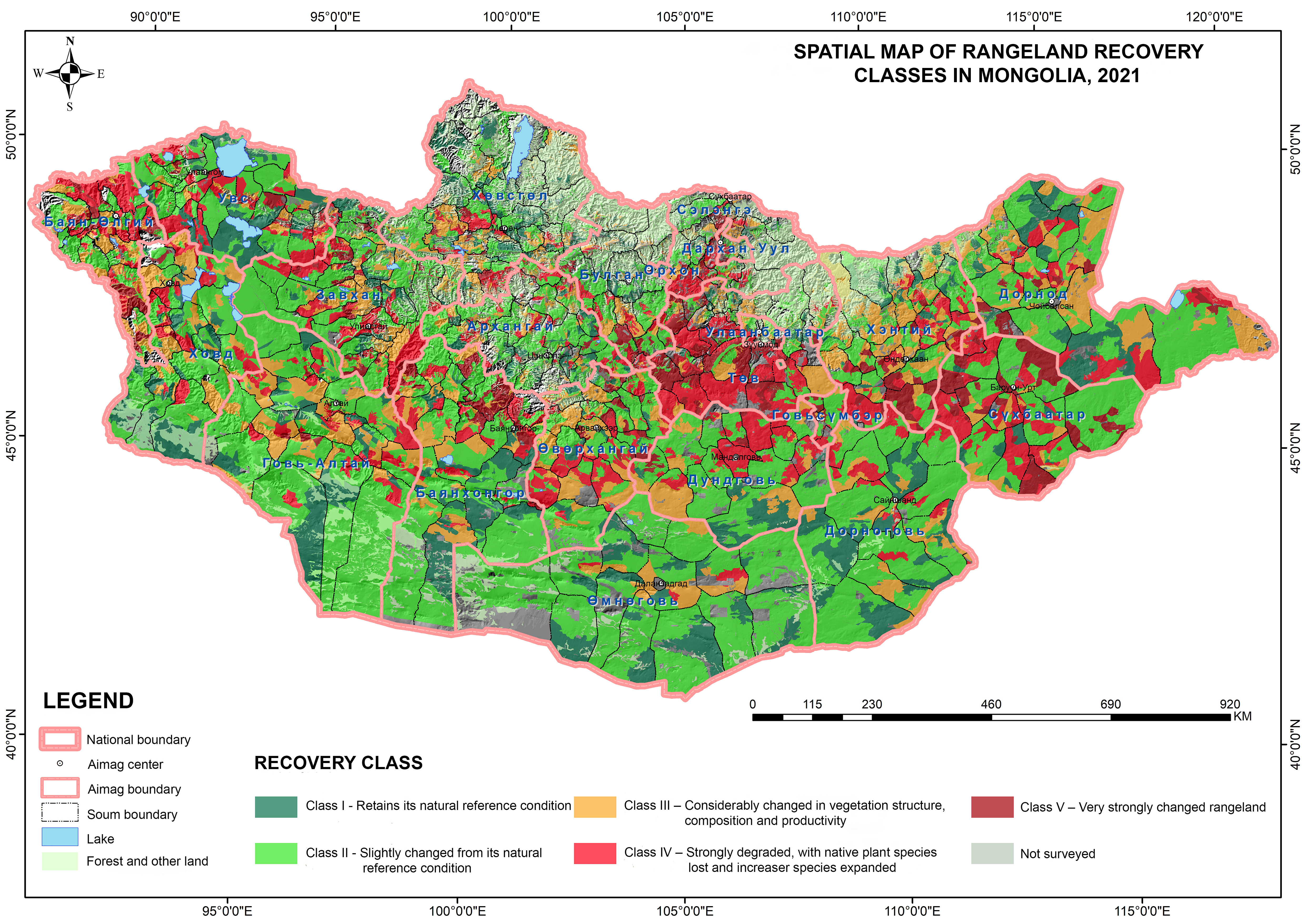
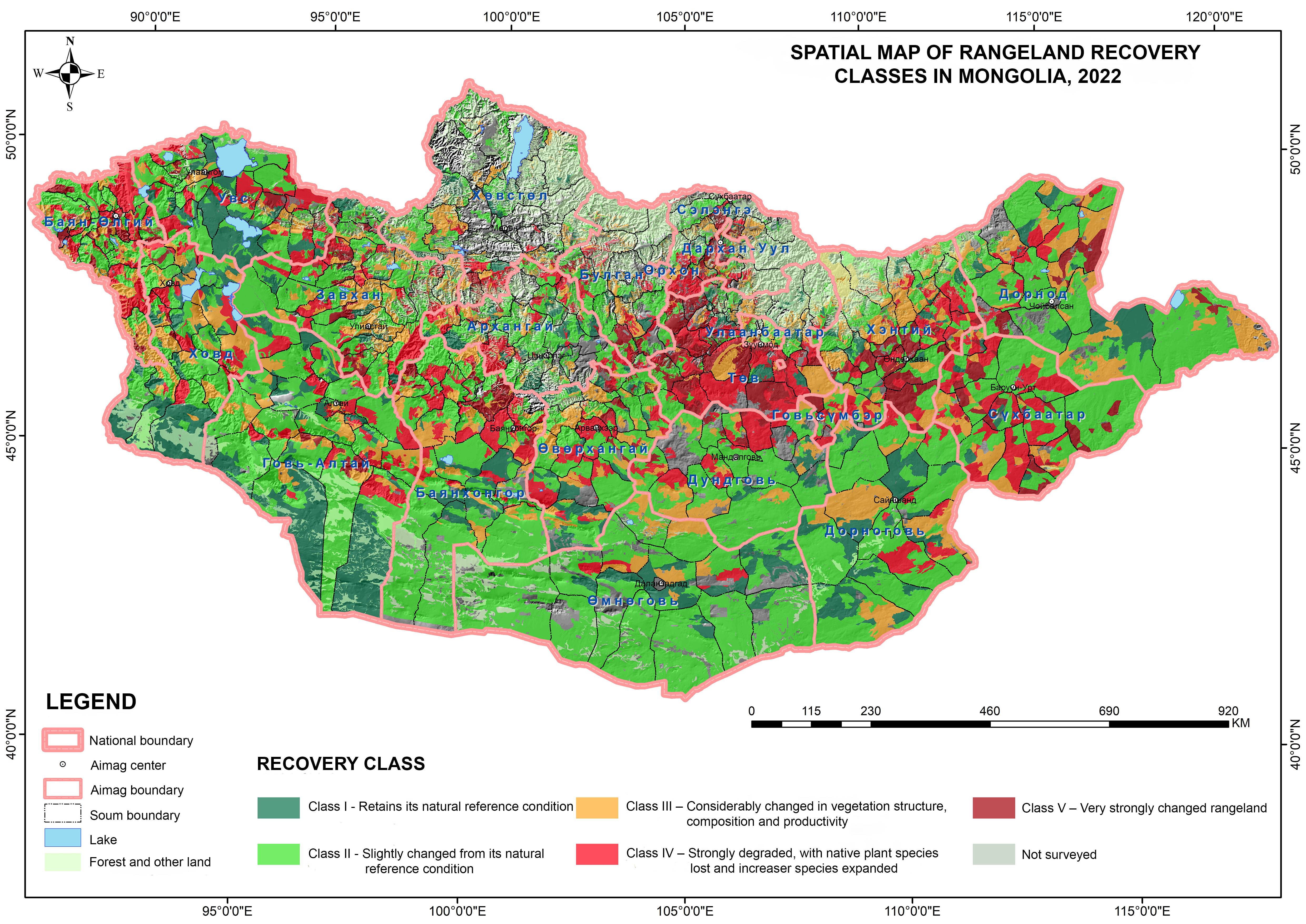
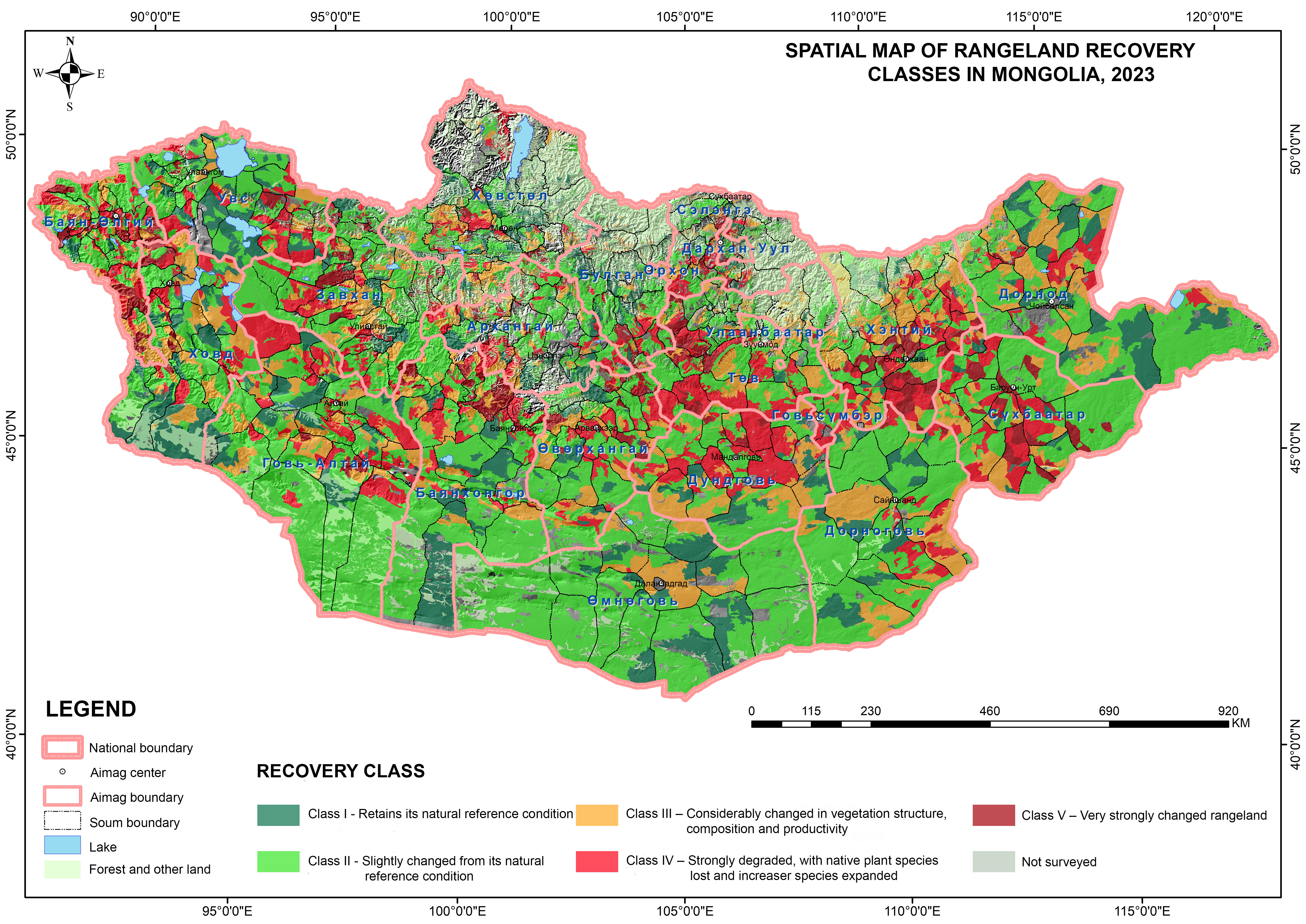
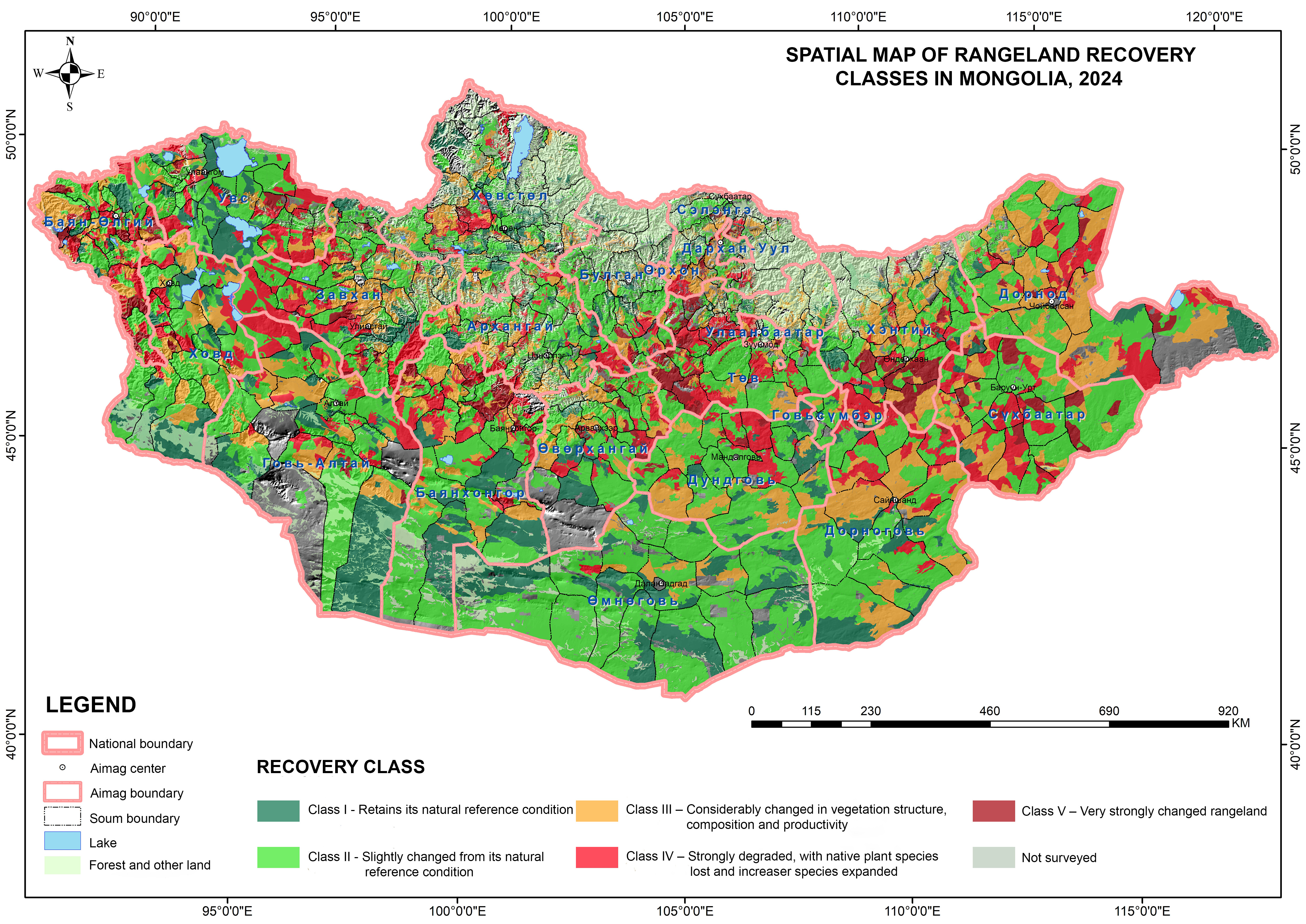
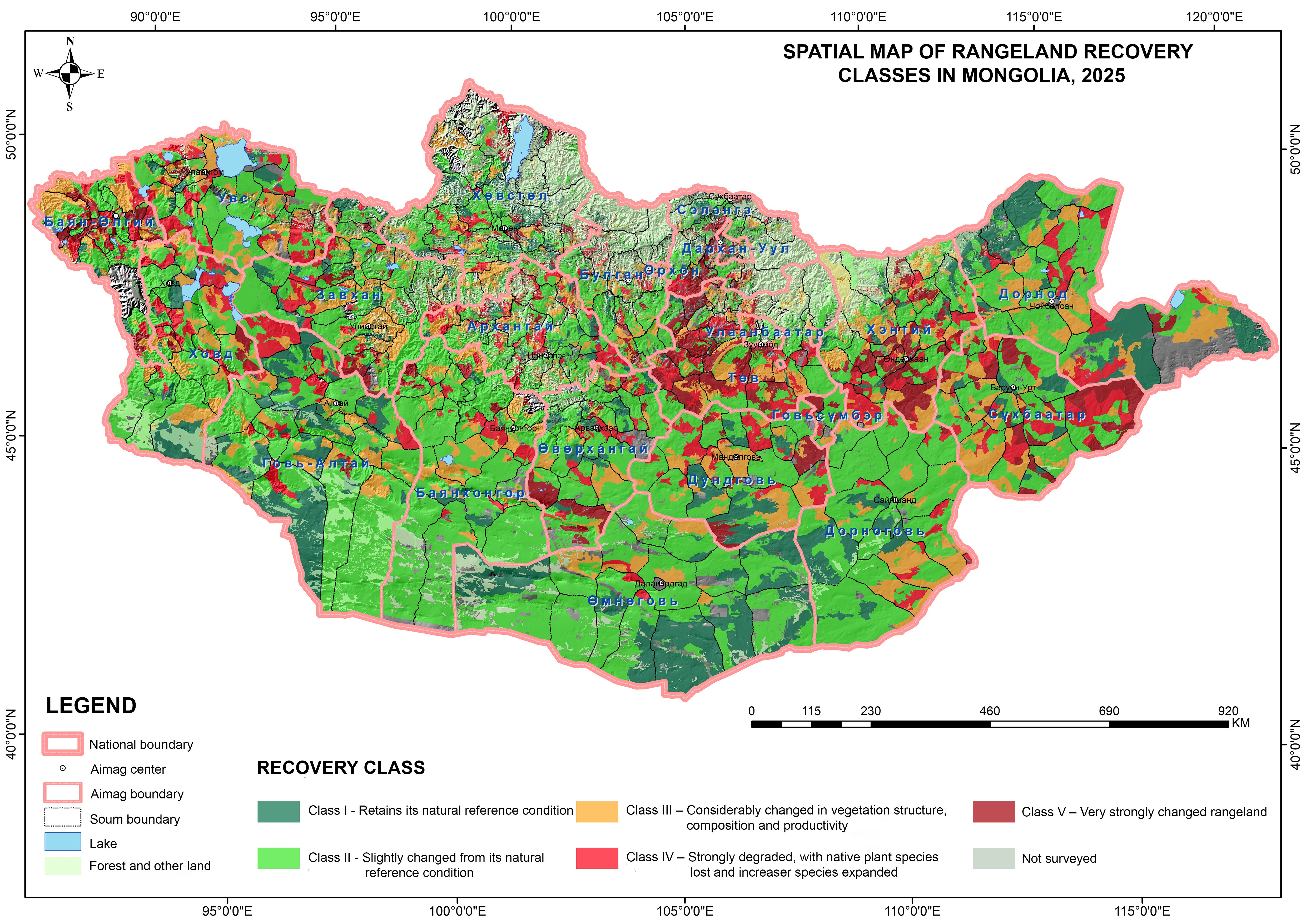
VIEWSpatial map of Rangeland Recovery Classes in Mongolia, 2020 - 2025
Contact
If you have any comments and feedback regarding this report, please contact us as follows.
address:
12th Government Building, 4th Khoroo, Chingeltei District, Ulaanbaatar, Mongolia
phone:
1800-0101
email:
info@gazar.gov.mn